What Is RAG and Why Should You Care?
Retrieval-Augmented Generation explained in plain English. What it is, how it works, where it adds value in consumer-facing businesses, and the tools that make it possible.
The problem RAG solves
Large language models like ChatGPT and Claude are impressive, but they have a fundamental limitation: they only know what they were trained on. Ask one about your company's returns policy, your product catalogue, or last quarter's sales data and it will either make something up or tell you it does not have that information.
This is the core problem. Businesses have vast amounts of proprietary knowledge locked in documents, databases, intranets, and systems. General-purpose AI cannot access any of it.
RAG (Retrieval-Augmented Generation) is the bridge. It connects an AI model to your organisation's own data, so the model can retrieve relevant information before generating a response. Instead of relying on what it was trained on, the model looks up the answer in your documents first, then uses that context to respond.
Think of it this way: without RAG, you are asking someone to answer questions from memory. With RAG, you are giving them access to a filing cabinet of your company's knowledge and letting them look things up before they respond.
How it works (without the jargon)
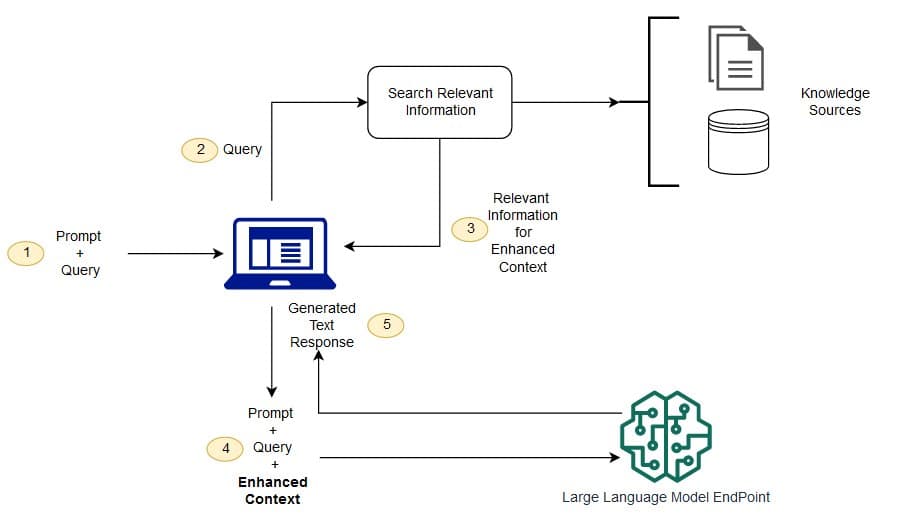
RAG has three steps:
1. Your documents are prepared and stored
Your company's knowledge (product guides, policies, FAQs, training materials, anything text-based) is broken into smaller chunks and converted into a mathematical representation called an embedding. These embeddings are stored in a specialised database called a vector database.
This happens once (with periodic updates as your content changes). It is the setup work.
2. A user asks a question
When someone asks a question, the system converts that question into the same kind of embedding and searches the vector database for the most relevant chunks of your content. This is the "retrieval" step. It finds the five or ten most relevant pieces of information from your own data.
3. The AI generates an answer using your data
The retrieved content is passed to the AI model along with the original question. The model now has the relevant context from your documents and can generate an accurate, grounded response. It is not guessing. It is working from your source material.
The result: answers that are specific to your business, based on your data, and far less likely to be wrong.
Why this matters for consumer-facing businesses
RAG is not an academic concept. It is being used in production by some of the largest consumer-facing businesses in the world. Here is where it is making a tangible difference:
Customer service
This is where most organisations start. RAG-powered chatbots can answer customer questions using your actual product information, returns policies, and support documentation rather than generic responses.
DoorDash built a RAG-powered voice support system for delivery drivers using Amazon Bedrock and Anthropic's Claude. It handles over 100,000 calls per day with response times under 2.5 seconds, significantly reducing escalations to live agents. They built it in eight weeks. You can read the full case study on AWS.
Klarna deployed an AI chatbot handling two-thirds of all customer service conversations across 23 markets and 35 languages, equivalent to roughly 700 full-time agents. Worth noting: Klarna later moved to a human-hybrid model after discovering quality issues with fully automated responses. The lesson is not that RAG does not work, but that the balance between automation and human oversight matters.
Internal knowledge management
Most organisations have critical knowledge scattered across SharePoint sites, Confluence pages, policy documents, and people's heads. RAG lets you build an internal assistant that can answer questions from across all of these sources.
"What is our process for handling a product recall?" Rather than someone spending 30 minutes finding the right document, the assistant retrieves the relevant policy, summarises the steps, and links to the source.
Product discovery and recommendations
For retailers and e-commerce businesses, RAG can power conversational product search. Instead of relying on keyword filters, customers can describe what they are looking for in natural language ("I need a waterproof jacket for hiking in Scotland, budget around £150") and the system retrieves matching products from your catalogue with reasons for each recommendation.
Staff training and onboarding
New employees can ask questions about company processes, systems, and policies and get accurate, sourced answers from your training materials. This is particularly valuable in retail and hospitality where staff turnover is high and consistent knowledge transfer is difficult.
What RAG is not
A few common misconceptions worth clearing up:
It is not fine-tuning. Fine-tuning changes the AI model itself by training it on your data. RAG leaves the model unchanged and instead gives it access to your data at query time. RAG is faster to set up, easier to update, and does not require machine learning expertise.
It is not a chatbot. RAG is the retrieval mechanism behind a chatbot (or any AI application). You can use RAG to power chatbots, search engines, internal tools, content generators, and more.
It is not infallible. RAG dramatically reduces hallucination (made-up answers) but does not eliminate it entirely. The quality of your source documents, how they are chunked, and how the retrieval is configured all affect accuracy. This is why Section 10 of the playbook includes a RAG Readiness Assessment and a RAG vs Alternatives Decision Guide.
The tools you will hear about
You do not need to become an expert in the tooling, but it helps to know the categories and the main players so you can have informed conversations with technical teams or vendors.
Vector databases
These store your document embeddings and handle the similarity search when a query comes in. The main options:
- Pinecone is fully managed and cloud-native. The most common choice for commercial applications. SOC 2, GDPR, and HIPAA certified.
- Weaviate is open-source with strong hybrid search (combining keyword and semantic matching). Available self-hosted or as managed cloud.
Orchestration frameworks
These connect the retrieval step to the AI model and handle the workflow:
- LangChain is the most widely adopted framework for building RAG applications. Modular and flexible with a large ecosystem.
- LlamaIndex is purpose-built for connecting AI to data sources. Often used alongside LangChain, with LlamaIndex handling retrieval and LangChain handling orchestration.
Enterprise platforms
If your organisation is already on a major cloud provider, their managed RAG offerings reduce the engineering effort significantly:
- Azure AI Search integrates with Microsoft 365 and Copilot. The natural choice for Microsoft-heavy organisations.
- AWS Bedrock Knowledge Bases provides managed RAG within the AWS ecosystem, including support for multimodal retrieval (text, images, audio, video).
The right choice depends on your existing technology stack, data volumes, and whether you want to build or buy. Your technical team or implementation partner will have a view, but knowing these names and what they do will help you ask the right questions.
Where to go from here
If you are evaluating whether RAG is right for your organisation, Section 10 of the playbook covers this in detail. The RAG Readiness Assessment helps you determine whether your data, infrastructure, and use cases are suited to a RAG approach, and the RAG vs Alternatives Decision Guide helps you compare RAG against other options like fine-tuning or traditional search.
For a more technical explanation of how RAG works under the hood, these are the best resources:
- AWS: What is Retrieval-Augmented Generation? is the clearest plain-English explainer available
- IBM Technology: What is RAG? is a seven-minute video walkthrough that covers the core concepts without assuming technical knowledge